

Why Mothers Can't Self-Care Their Way Out of Survival Mode: A Myotherapist's Perspective on Motherhood, Trauma and Learning to Feel Safe Again by Maddie Green
As mothers, we're constantly told to practise self-care.
Take the bath. Book the massage. Go for the walk. Drink the tea while it's still hot. Meditate. Journal. Breathe.
And yet, so many of us find ourselves lying awake at night after everyone else is asleep, exhausted to our bones, desperately wanting to relax but feeling utterly incapable of doing so.
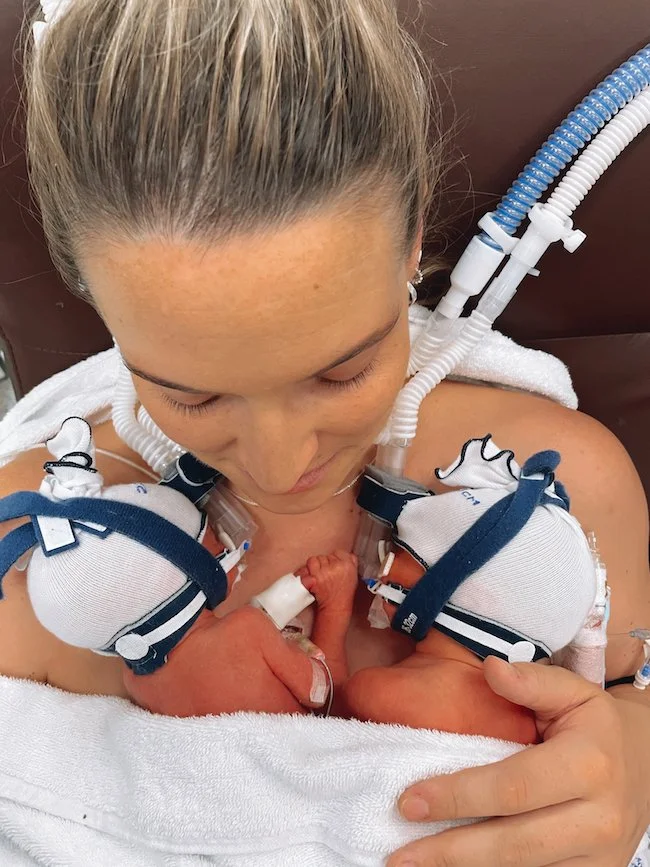
As a Clinical Myotherapist, health coach, and mother to twin girls who arrived prematurely at just 31 weeks gestation, I've come to believe that the problem isn't that mothers aren't trying hard enough to care for themselves. The problem is that many mothers are living in a state of nervous system survival, and no amount of bubble baths can override a body that doesn't feel safe.
For years in clinical practice, I observed the same pattern. Patients would arrive with chronic neck and shoulder pain, headaches, jaw tension, digestive issues, pelvic pain, fatigue, anxiety, and a profound sense of disconnection from themselves. They often believed their symptoms existed in isolation, as separate problems requiring separate solutions.
But what I witnessed over and over again was something much deeper: the body keeping score of a life lived under chronic stress.
Then I became a mother.
And not just any mother, but a mother to premature twins whose journey into the world changed my understanding of the nervous system forever.
At just 25 weeks pregnant, I went into threatened preterm labour. Overnight, I entered a world of uncertainty, hypervigilance, and fear. I spent the next eight weeks admitted to hospital, living day-to-day with the knowledge that my babies could arrive at any moment.
Every sensation in my body became something to monitor. Every medical review carried the possibility of devastating news. I learned to sleep lightly, remain vigilant, prepare for the worst, and hold onto hope all at the same time.
When my daughters eventually arrived at 31 weeks gestation, my journey wasn't over. It was just beginning.
I spent another two and a half months navigating the NICU and Special Care Nursery, living away from home in another state because I had been transferred to the nearest hospital with a tertiary neonatal intensive care unit. Home became hospital corridors, Ronald McDonald House rooms, pumping schedules, monitors, oxygen saturations, daily medical rounds, and the constant emotional whiplash of celebrating tiny milestones while fearing what could happen next.
Even after I finally brought my daughters home, I realised something profound: my body had never received the message that the crisis was over.
I remained on high alert.
I slept lightly, listened constantly, anticipated danger, prepared for worst-case scenarios, and carried the invisible mental load of motherhood with a determination that I mistook for strength. I continued to function. I continued to care for everyone else. But underneath it all, my nervous system was operating as though there was still an emergency unfolding.
And if you're reading this as a mother who feels constantly exhausted, overstimulated, anxious, reactive, numb, overwhelmed, or physically unwell, I want you to know that there may be nothing "wrong" with you.
Your body may simply be doing exactly what it was designed to do.
Our nervous systems evolved to keep us alive. When we perceive threat, uncertainty, overwhelm, sleep deprivation, grief, trauma, or prolonged stress, our bodies shift into protective states. We become hyper-alert, vigilant, productive, and capable of pushing through extraordinary circumstances.
The challenge is that motherhood itself contains many of the exact ingredients that activate our survival responses.
Interrupted sleep.
Constant responsibility.
Emotional labour.
Decision fatigue.
Hypervigilance.
The pressure to hold everyone together.
The expectation that we continue functioning regardless of our own needs.
And for mothers who have experienced birth trauma, NICU admissions, pregnancy complications, pregnancy loss, relationship stress, previous trauma, or simply the enormous transition into becoming a mother, these protective responses can become deeply embedded.
As a myotherapist, I see this every day in the body.
I see it in the shoulders that haven't dropped in years.
The jaws that remain clenched long after the children have gone to bed.
The shallow breathing patterns.
The pelvic floors that never fully relax.
The chronic headaches, digestive disturbances, persistent pain, and exhaustion that mothers so often dismiss as simply "part of having kids."
But our bodies are always communicating with us.
And perhaps one of the greatest misconceptions about self-care is the idea that we can think our way out of a nervous system state that is fundamentally physiological.
You cannot shame, productivity-hack, or bubble-bath your way out of survival mode.
What your nervous system needs most is not more pressure to perform wellness perfectly.
It needs experiences of safety.
This might look less like a morning routine worthy of Instagram and more like stepping outside barefoot for five minutes while feeling the warmth of the sun on your face.
It might look like asking for help.
Allowing someone else to hold the baby while you shower.
Taking three conscious breaths before responding to your toddler.
Having a good cry with a trusted friend.
Moving your body not to burn calories, but to release stress.
Sitting quietly with a cup of tea after everyone is asleep and allowing yourself to acknowledge that this season is hard.
Regulation doesn't require perfection. It requires permission.
Permission to stop performing.
Permission to be supported.
Permission to acknowledge that motherhood is both profoundly beautiful and profoundly demanding.
As both a clinician and a mother, I've come to believe that healing isn't about returning to who we were before children. It's about learning to create safety, compassion, and connection within ourselves as we become who we are now.
If you feel like you're constantly surviving motherhood rather than experiencing it, please know that you are not failing.
Your body is not broken.
Your nervous system is not working against you.
It has been working tirelessly to protect you.
And perhaps the most radical act of self-care available to mothers is not trying harder, but finally allowing ourselves to feel safe enough to soften.
Maddie Green is a Clinical Myotherapist, health coach, and founder of Whole Myotherapy in Melbourne, Australia. With over a decade of clinical experience, Maddie has a special interest in nervous system regulation, chronic pain, women's health, pregnancy and postpartum recovery. She is also a mother to twin daughters born prematurely at 31 weeks following eight weeks of hospitalisation for threatened preterm labour and a subsequent two-and-a-half-month NICU and Special Care journey while living away from home. This experience profoundly shaped both her personal healing journey and professional approach to care. Maddie is passionate about helping women understand the connection between their bodies, nervous systems, and lived experiences, empowering them to move from survival mode toward safety, connection, and healing.
Website: www.wholemyotherapy.com
Instagram: @wholemyotherapy