

Why Talking About Cancer Early Matters More Than You Think by Dr. Sanjay Juneja

If there’s one thing I’ve learned after years of caring for patients and families, it’s this: silence around cancer often creates more fear than the disease itself.
In the introduction of We Need to Talk About Cancer, I wrote about how a cancer diagnosis doesn’t just affect the patient—it reshapes the emotional landscape of an entire family. Children, spouses, and caregivers are suddenly faced with unfamiliar words, uncertain timelines, and a swirl of emotions they may not feel equipped to express. And when we don’t talk about it? Those questions don’t go away—they grow louder, often in the quiet.
For families—especially those with children—open conversations are not just helpful, they are protective.
Kids, in particular, are incredibly perceptive. They sense when something is wrong long before anyone says it out loud. When we avoid the conversation, we unintentionally leave them to fill in the gaps themselves—and their imaginations are often far scarier than reality. Honest, age-appropriate communication gives them something powerful: a sense of grounding in a situation that otherwise feels completely out of control.
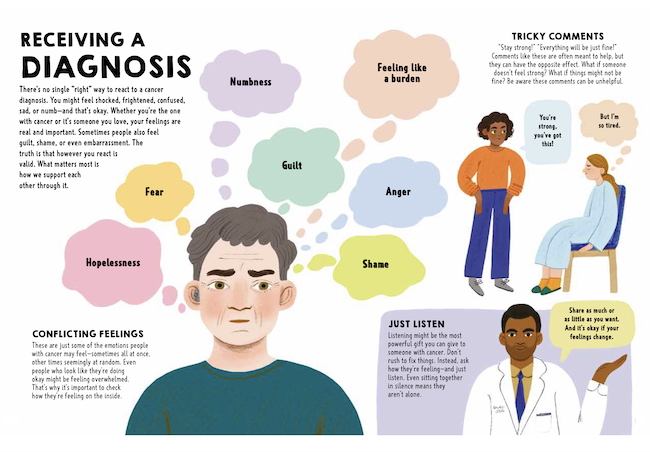
Another section that I consider essential is the chapter on receiving a diagnosis. It highlights something we don’t talk about enough: there is no “right” way to react. Fear, anger, guilt, numbness—these emotions can all exist at once. Families often feel pressure to “stay strong” for one another, but that can actually create emotional distance instead of connection.
What truly helps? Presence.
Not perfect words. Not forced optimism. Just being there.
One of the most powerful lines in that section is the reminder that listening—truly listening—is one of the greatest gifts you can give someone facing cancer. For families, this means creating space where everyone—kids included—can express what they’re feeling without fear of being corrected or dismissed.
For the Your Zen Mama community, this is where emotional wellness and medical reality intersect beautifully. These conversations are not about overwhelming your family with information. They’re about creating emotional safety.
When we talk openly:
Fear becomes something we can name (and therefore manage)
Children feel included instead of isolated
Partners feel supported instead of alone
Families move from chaos to connection
Cancer introduces uncertainty—but communication restores a sense of control. And here’s the truth I want every family to hold onto: you don’t have to have all the answers to start the conversation. You just have to be willing to sit in it together. Because in the middle of something as heavy as cancer, connection is what carries people through.
Dr. Sanjay Juneja is a triple board-certified hematologist and medical oncologist serving as Vice President of AI & Medical Informatics for Tempus AI. In this role, he leads clinical AI strategy and implementation initiatives that bridge cutting-edge artificial intelligence with real-world oncology practice. He is also the author of “We Need to Talk About Cancer: An IMPORTANT Book for Patients, Family, and Friends.”
Dr. Juneja maintains an active clinical practice with Citrus Oncology while advancing the field through his expertise in AI applications in medicine. He completed Harvard's inaugural Executive Education program in AI in Healthcare: from Strategies to Implementation and serves on the Editorial Board of the peer-reviewed journal AI in Precision Oncology. Through his platform as "TheOncDoc," Dr. Juneja has built a global following of over 750,000 healthcare professionals and researchers, translating complex AI and oncology concepts for clinical audiences. His podcast series on AI and Healthcare has topped 5 million downloads in over 110 countries, fostering international dialogue on the future of technology-enabled medicine. For more information visit: https://sjunejamd.com/ and follow @theoncdoc on Instagram and TikTok.