
Loose Parts Play Using Nature
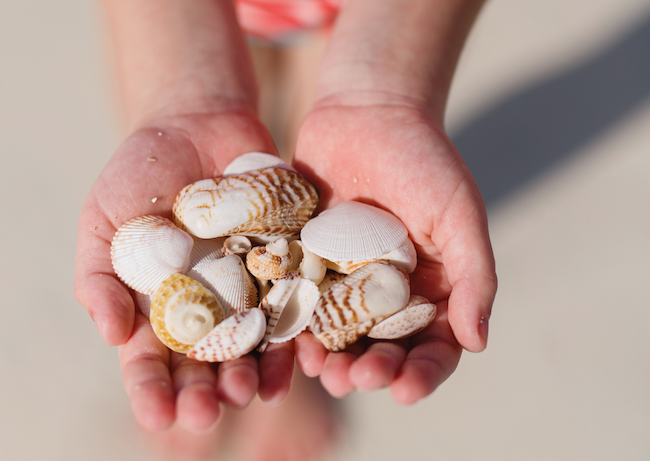
Long before the phrase loose parts play found its way into parenting books and early childhood classrooms, children were already doing it instinctively. Children have a habit of bringing home things adults would almost certainly leave behind. A smooth stone discovered halfway through a walk somehow finds its way into a pocket. A feather is carried carefully all the way home. There are sticks that are apparently too interesting to put down, gum nuts collected by the handful, seed pods, pinecones, shells, curled autumn leaves and flowers that have already fallen from the tree. By the time the day is over, the kitchen bench has become a small museum of ordinary things that no longer seem quite so ordinary. It can be tempting to see these collections as clutter. Another pocket full of pebbles to empty before the washing goes on, another pile of leaves that will eventually dry out and crumble across the table. But children aren't collecting objects for the sake of collecting them. They're gathering possibilities.
Loose parts are exactly what they sound like: materials that can be moved, combined, arranged, taken apart and used in countless different ways. Unlike toys with a single purpose, they invite children to decide what they might become. Nature happens to provide some of the richest loose parts of all. A stick can spend one afternoon as a magic wand before becoming a fishing rod, a flagpole, a bridge for toy animals or part of an elaborate den. Pinecones become woodland creatures, ingredients in a pretend bakery or treasure hidden along a garden path. Flat stones transform into stepping stones across imaginary rivers, game pieces or tiny canvases waiting to be painted.
The same branch that spent the morning being carefully examined might become part of a cubby in the afternoon. A collection of stones is rearranged into stepping paths for imaginary animals before becoming the walls of a tiny village built beneath a tree. Tomorrow, those very same pieces will almost certainly become something entirely different. Nothing has changed except the story surrounding them, and that seems to be more than enough.
There is something beautiful and refreshing about materials that arrive without instructions, maybe because most modern toys come with an expectation attached. They suggest how they should be played with, what they should become and, often, how the finished result ought to look. Natural objects don't ask for any of that; pinecone never insists on being a pinecone, a stick never insitsts on being anything more than a stick. It is simply whatever a child needs it to be that day.
Watching children play this way is a reminder that imagination doesn't always need more resources, but rather, more often than not, it needs fewer. A basket filled over the course of a few family walks can become one of the most versatile collections in a home. Smooth river stones, bark, feathers, seed pods, driftwood, shells, dried grasses, fallen blossoms and interesting leaves all invite slightly different kinds of play without demanding anything in return. Some children naturally begin sorting them by colour or size. Others build intricate patterns across the ground, balancing one object against another until something beautiful begins to emerge almost accidentally. Some create entire imaginary worlds, complete with tiny houses, winding roads and woodland characters whose stories grow more elaborate each time they return.
What makes this kind of play feel so different is that there isn't really an end point. There is nothing to finish, no picture to compare against and no expectation that the creation will last beyond the afternoon. A carefully balanced sculpture may fall apart in the wind. A nature mandala disappears when someone walks through it. Tiny fairy houses gradually become part of the forest floor again. None of this feels like failure because permanence was never the goal.
Children seem to understand this instinctively. Adults, perhaps, have a little more to learn from it.
There is a certain freedom in creating something simply because the making itself is enjoyable. Without realising it, children spend long stretches solving problems, experimenting with balance, exploring patterns, inventing stories and making decisions entirely on their own. The learning happens almost invisibly because nobody has interrupted to call it learning.
Loose parts play also changes the way families move through outdoor spaces. A walk becomes slower, but in the best possible sense. Instead of moving from one destination to the next, children begin noticing details that would otherwise pass by unnoticed: the seed pods that look like tiny boats, bark with deep grooves perfect for miniature worlds, leaves in five different shades of green, a feather resting so lightly on the grass that it almost disappears. The landscape becomes something to interact with rather than simply pass through.Perhaps that's why these collections matter so much to children. They're not bringing home sticks and stones because they lack better toys. They're bringing home evidence that they noticed something. Something beautiful. Something unusual. Something worth wondering about.
In a childhood that can so easily become filled with brightly coloured plastic and activities designed to achieve a particular outcome, there is something wonderfully grounding about watching imagination unfold with nothing more than the things nature has quietly provided all along. The treasures children gather aren't valuable because of what they are. They are valuable because of what they allow children to imagine, and because they remind us that the richest forms of play have never depended on having more. Sometimes they begin with nothing more than a stick, a pocket full of pebbles and enough unhurried time to wonder what they might become.