

Growing Food With Children
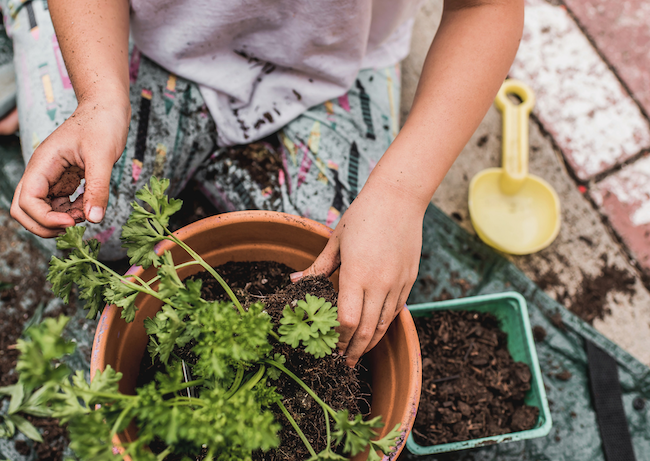
Few things spark a child's curiosity quite like discovering that the food on their plate once started as a tiny seed.
The idea feels almost unbelievable at first. A carrot hidden beneath the soil, tomatoes forming from flowers, herbs growing from what looked like little more than dust. When children are given the chance to grow food themselves, they begin to see familiar foods through entirely new eyes, and in the process, they often develop a deeper appreciation for the natural world that sustains them.
Most adults can remember growing something as a child, even if it was only a bean seed in a paper cup sitting on a windowsill. Perhaps that memory stays with us because watching something grow feels quietly remarkable. For children, the process can transform food from something that simply appears on a plate into something living, changing, and connected to the natural world around them.
In a world where so much arrives instantly, growing food offers children a different experience entirely. It introduces them to processes that cannot be rushed. Seeds do not sprout because we want them to. Tomatoes do not ripen faster because we check them every hour. Nature moves at its own pace, and children learn to move alongside it.
Many parents are surprised by how invested children become once they feel a sense of ownership over a garden space. A child who refuses a tomato at the dinner table may suddenly become fascinated by the tomato plant growing outside. They check on it daily. They notice the flowers. They celebrate the first tiny green fruit. By the time it reaches the plate, it is no longer just a tomato. It is something they have watched, cared for, and anticipated.
The learning that happens through growing food is difficult to fit neatly into a category because it touches so many parts of development at once.
Children begin noticing seasons in a more meaningful way. They start paying attention to weather patterns, sunlight, rainfall, insects, and changes in the natural world. They learn that living things have needs and that growth takes time. They experience responsibility through watering and caring for plants, but they also encounter disappointment when things do not go according to plan.
Sometimes seeds fail to sprout.
Sometimes plants are eaten by insects.
Sometimes a carefully tended crop produces far less than expected.
These moments can be frustrating, but they are valuable too. Gardening gently teaches children that not everything can be controlled, and that setbacks are often part of the process rather than evidence of failure.
Perhaps one of the most overlooked benefits of growing food is how it reconnects children with where food actually comes from.
For many children, food appears fully formed on supermarket shelves. Strawberries are simply strawberries. Lettuce arrives in bags. Herbs come from containers. Growing even a small amount of food begins to tell a different story. Children see the journey between seed and plate. They begin to understand that food is something grown, nurtured, harvested, and prepared. This understanding often creates a deeper appreciation for what they eat.
Not always immediately. Growing food is not a guaranteed solution for picky eating, despite what some headlines might suggest. But it can help children become more curious. A child who has spent weeks watching peas grow is often more willing to taste one, even if they ultimately decide they do not like it. Curiosity tends to be a much more powerful starting point than pressure.
The beauty of gardening with children is that it does not need to be elaborate. A large backyard is not required. Herbs on a windowsill, strawberries in a pot, lettuce in a raised garden bed, or a few bean plants climbing a trellis can provide just as much wonder as a larger garden. Children rarely judge a garden by its size, they are often more interested in the experience itself. Digging holes. Finding worms. Watering plants. Watching tiny green shoots emerge from the soil after what feels like an impossibly long wait.
There is also something calming about the rhythm of gardening. It encourages observation rather than urgency. Unlike many activities designed for children, there is no expectation of immediate results. Growth happens slowly, often invisibly at first. Days can pass without much apparent change, and then suddenly a seedling appears, a flower opens, or something becomes ready to harvest. That slower pace feels increasingly valuable.
Many children move through environments filled with noise, schedules, and constant stimulation. A garden offers something different. It invites them to pay attention. To notice small changes. To spend time outdoors without needing entertainment or direction. The sensory experience of soil, leaves, water, and sunlight can be surprisingly regulating, particularly for children who spend much of their day moving between structured activities. And perhaps that is part of what makes growing food with children so worthwhile. The vegetables themselves are almost a bonus.
What children are really cultivating is patience, curiosity, responsibility, resilience, and a relationship with the natural world that cannot be learned from a screen or a book alone. Long after the tomatoes have been picked and the herbs have gone to seed, those lessons tend to stay with them.
Not because they were taught explicitly, but because they were experienced firsthand, one season at a time.