

Folks We Love: Megan Dalla-Camina
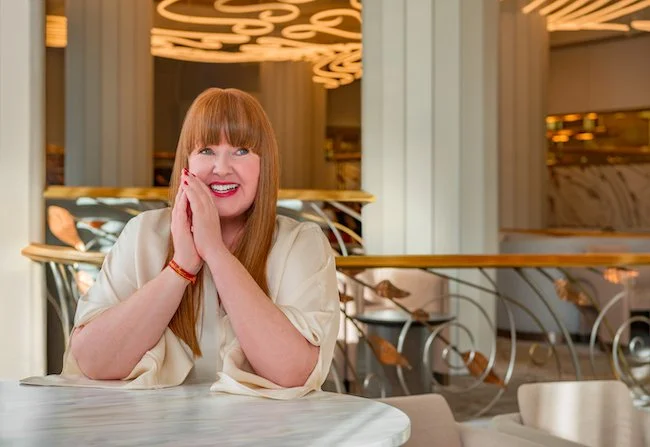
Megan Dalla-Camina has spent much of her career thinking about what it means to build a life and career that actually feels good to live. A writer, researcher, strategist and author, she brings a thoughtful perspective to the questions so many women find themselves asking as life changes shape: how we work, how we lead, what we value and what we want the next chapter to look like.
Her work has a lovely way of making big ideas feel practical and deeply human, whether she is writing about women's lives, leadership, wellbeing or the complicated business of figuring out what comes next. For our Folks We Love series, we sat down with Megan to talk about the lessons she has learned along the way, the ideas currently occupying her mind, and the things she comes back to when life gets a little full.
You’ve spent much of your career researching and writing about women, leadership and achievement. What was happening in your own life when you realised there was another conversation you needed to have with women?
I’d spent more than two decades working with women, first inside some of the world’s largest organisations and then through my own work, helping women navigate leadership, ambition, confidence and success. And I still deeply believe in that work. But somewhere along the way, I started to feel that there was another conversation underneath it.
I could see it in the women I worked with, but I could also feel it in myself. We could become more confident, more successful, more influential and more capable, and still feel disconnected from ourselves. We’d learnt how to achieve, but many of us hadn’t learnt how to listen deeply to ourselves, trust what we knew, honour what we needed, or ask whether the life we’d worked so hard to create was actually the life we wanted.
That became the doorway into She Who Remembers. I became interested in what sits beneath all of our doing and achieving. Who are we underneath the roles, expectations and identities we’ve accumulated? What have we forgotten about ourselves along the way? And what might it mean to come home to ourselves?
She Who Remembers is about returning to something many women have lost touch with: their own inner wisdom.
What do you think gets in the way of hearing that voice in the first place?
Noise, mostly. The noise of expectation, responsibility, productivity, other people’s opinions, social conditioning and the sheer fullness of modern life.
Women are incredibly well trained to look outside themselves for answers. We learn what a good woman looks like, what success looks like, what a good mother looks like, what we should want, how we should behave and how much we should be able to carry. Over time, all of those external voices can become louder than our own.
Our inner wisdom is often much quieter. It might arrive as a feeling in the body, a sense that something isn’t right, a longing we can’t quite explain, or a knowing that keeps returning even when we try to rationalise it away. The challenge isn’t necessarily that we’ve lost that wisdom. I think we’ve often lost the practice of listening to it and trusting what we hear.
You write about the conditioning of constant achievement and self-abandonment. What does self-abandonment actually look like in everyday life?
It can look incredibly ordinary, which is why it’s so easy to miss. It’s saying yes when everything inside you is saying no. It’s overriding exhaustion because there’s still more to do. It’s knowing that a relationship, job or situation isn’t right for you and staying because leaving would disappoint someone. It’s continually putting your own needs at the bottom of the list and calling it being responsible.
For high-achieving women, self-abandonment can even look like success. You can be doing everything you were told would make you happy while becoming increasingly disconnected from yourself. You become so skilled at meeting expectations and being who everyone needs you to be that eventually you have to ask: where am I in all of this?
For me, the opposite of self-abandonment isn’t selfishness. It’s self-relationship. It’s learning to stay with yourself, listen to yourself and include yourself in the decisions you make about your own life.
I’m interested in the idea that you can be incredibly successful and still have a feeling that something is missing. Why do you think so many women reach that point?
Because success can answer many questions, but it can’t necessarily answer the deepest ones.
Achievement can give us security, opportunity, recognition and a sense of purpose. All of those things matter. But eventually many women arrive at a point where the questions change. Instead of asking, “What can I achieve?” or “What should I do next?” we start asking, “Is this meaningful to me?”, “Who am I becoming?” and “Is this how I actually want to live?”
I don’t think that means everything that came before was wrong. I certainly don’t feel that way about my own ambition or career. It means we’ve changed. The life that was right for us at thirty may not be the life that fits us at fifty. There’s enormous freedom in allowing ourselves to acknowledge that.
Is there a particular age or stage of life when women tend to start questioning the version of themselves they’ve spent years constructing?
Midlife is certainly a powerful threshold for this. By then, many women have spent decades building careers, raising children, sustaining relationships, caring for family and being enormously capable. We’ve accumulated identities and responsibilities, and then something starts asking for our attention.
Sometimes it’s menopause. Sometimes children leave home, a relationship changes, a parent dies, work loses its meaning, or we simply realise that time is passing. The questions become harder to avoid.
But I don’t think this belongs exclusively to midlife. These moments can happen whenever the identity we’ve constructed no longer matches the person we’re becoming. What midlife often gives us is a particular kind of urgency. There’s a sense that if we’re going to live more truthfully, now might be the time.
You’ve described this work as a return to feminine wisdom. What does “feminine wisdom” mean to you, particularly in a culture that has historically rewarded women for being productive, rational and endlessly capable?
For me, feminine wisdom is our deepest inner knowing. It’s the wisdom of the body, intuition, lived experience and the heart, alongside the intellect rather than in opposition to it.
I don’t see these qualities as belonging exclusively to women. They’re human capacities. But many of the qualities historically associated with the feminine, including receptivity, intuition, embodiment, relationship, cyclical ways of being and deep listening, have been devalued in cultures that privilege rationality, productivity, certainty and constant forward motion.
So when I talk about reclaiming feminine wisdom, I’m not suggesting women become less ambitious, less intelligent or less capable. I’m interested in what becomes possible when we stop privileging one way of knowing over all others. When we can think and feel, act and receive, achieve and be present. For me, that’s a movement towards greater wholeness.
Do you think we’ve become so accustomed to overriding our intuition that we sometimes don’t even recognise it anymore?
Absolutely. I think many women experience intuition all the time but have become incredibly skilled at talking themselves out of it.
We get a feeling about someone and immediately tell ourselves we’re being judgemental. We know we need to rest and tell ourselves we should push through. We sense that something is finished and then create a ten-point argument for why we should stay.
Intuition rarely arrives with a PowerPoint presentation and supporting evidence. That can make it difficult for women who’ve been rewarded for being rational, competent and certain. Part of the work is learning to notice the quieter signals again and developing discernment around them. Not every feeling is intuition, and inner wisdom doesn’t mean abandoning reason. It means widening the ways we allow ourselves to know.
Your work explores embodiment, but so much of modern womanhood seems to happen from the neck up; thinking, planning, achieving, anticipating. What does it mean to actually come back into the body?
I know the neck-up life very well. I’ve spent much of my life thinking, planning, creating and achieving, and those are capacities I value. But embodiment asks us to include the rest of ourselves in the conversation.
Coming back into the body can be incredibly simple. It’s noticing how you actually feel before automatically saying yes. It’s recognising tension, fatigue, pleasure, expansion or contraction. It’s walking, breathing, practising yoga, meditating, dancing, being in nature or simply sitting quietly enough to notice what’s happening inside you.
Our bodies are communicating with us constantly. The question is whether we’re listening. For me, embodiment isn’t another self-improvement project. It’s a way of inhabiting my own life more fully.
You’re a mother, as well as someone who has spent years thinking deeply about women’s lives. How has motherhood changed your understanding of identity and who we are beneath the roles we play?
Motherhood has been one of the great identities of my life, and also one of the experiences that has taught me most clearly that we’re never only our roles.
When my son was young, motherhood was incredibly consuming, as it is for so many women. Your life reorganises around another human being. Then they grow, and the relationship changes, and you’re reminded that your role was never to hold them in place. It was to love them while they became themselves.
I think there’s something in that for women too. We move through so many identities across a lifetime: daughter, mother, partner, leader, caregiver, creator. They’re real and meaningful, but none of them is the whole of us. There’s a self underneath those roles that continues to grow and change, and part of our work is staying in relationship with her.
You’ve written for YZM before about raising a conscious son while healing yourself. Looking back on that piece now, what has changed for you as a mother since you wrote it?
So much has changed, largely because my son is now a man and motherhood has changed shape again. There’s much less doing and much more witnessing.
When I wrote that piece, I was thinking deeply about what it meant to raise a conscious boy while also looking at my own patterns, wounds and conditioning. I still believe we parent our children partly through the work we’re willing to do on ourselves. But I think I hold it all more lightly now.
I have enormous respect for the person my son is and for the fact that his life belongs to him. My work isn’t to shape every part of it. It’s to love him, be available, tell the truth when it matters and trust what we’ve built together. There’s something incredibly beautiful about watching your child become fully themselves.
What have you had to unlearn about ambition?
That more is always better.
I’ve been ambitious for most of my life, and I don’t think ambition is something women need to apologise for. It’s given me an extraordinary career, businesses I care deeply about, books I’m proud of and work that has reached women all over the world.
What I’ve had to unlearn is the belief that the finish line must keep moving. That every achievement needs to be followed immediately by the next goal. That growth always means bigger. That rest has to be earned.
I’m much more interested now in asking what my ambition is in service of. Does it make my life richer? Does it allow me to contribute in a meaningful way? Is it coming from desire or from some old belief that I still need to prove something? Those questions have changed my relationship with ambition enormously.
Do you think there’s a difference between giving up on ambition and allowing ambition to evolve?
Completely. I don’t want to give up my ambition. I still have things I want to create, learn, write and contribute. I’m doing a PhD in my fifties, so clearly the ambitious part of me is alive and well.
But ambition can mature. It can become less about proving and more about purpose. Less about accumulating and more about deepening. Success doesn’t always have to mean bigger, faster or more visible. What I'm finding is that my ambition is still here, but it's much quieter, and it's more for me than for anyone else.
Sometimes ambition evolves from wanting to conquer the world to wanting to inhabit your own life beautifully. I don’t think that’s shrinking. I think it can be an expansion into a much fuller definition of what a successful life actually is.
What do you think women in midlife are particularly hungry for that they may not have known how to articulate when they were younger?
I think many women reach midlife with a deep hunger for space, meaning, freedom, truth and a more intimate relationship with themselves. We want to know what we actually think when we’re not responding to everybody else’s needs and expectations. We want to know what we desire now, not what we wanted twenty years ago.
There can also be a spiritual hunger that’s difficult to name. Not necessarily for religion, but for depth, connection, ritual, meaning, nature, mystery, something beyond the endless mechanics of daily life.
Perhaps when we’re younger, we’re often occupied with becoming someone. Midlife can bring a different invitation: to discover who we are beneath everything we became.
If a woman reading this has that nagging feeling that she has somehow lost herself somewhere along the way, where would you tell her to begin looking?
I’d tell her not to make finding herself another enormous project.
Start with a little space. Ten quiet minutes. A walk without a podcast. A page in a journal. Sitting outside with a cup of tea. Then ask yourself something simple: What do I know right now that I haven’t been willing to listen to?
Don’t force an answer. Just notice what comes.
I don’t really believe we lose ourselves completely. I think we lose contact with ourselves. There’s a difference. The woman you’re looking for isn’t somewhere out there waiting to be discovered. She’s still here. The practice is learning how to hear her again.
And, because we always like to know the woman behind the work, what are a few things making life particularly good for you at the moment; books, rituals, places, people, little pleasures, anything you’re loving?
My life is actually quite simple at the moment, and I’m loving that. I spend a lot of time reading and writing for my PhD, which is stretching me in all sorts of ways and bringing me into conversation with women thinkers and spiritual traditions that are changing how I understand my own work.
My spiritual practice is a very important anchor in my life. Meditation has been part of my world for more than twenty-five years, and these days I’m also deeply devoted to my own ritual and contemplative practices. India has become a significant place for me, particularly Varanasi, and I’m returning there again soon for pilgrimage and practice.
And then there are the very ordinary pleasures: long walks, beautiful books, chai, flowers, wearing gorgeous vintage silks at home for absolutely no reason, conversations with the people I love, and quiet time with my son. I think I’m learning to appreciate the texture of my actual life rather than always racing towards the next version of it. There’s a lot of joy in that.
Megan Dalla-Camina is a bestselling author, women’s leadership expert and the founder of Women Rising, whose programs have supported thousands of women around the world. Her latest book, She Who Remembers, explores feminine wisdom, self-trust and what it means for women to come home to themselves. Megan is also a PhD researcher exploring women’s spirituality and feminine wisdom, and has spent more than two decades studying, writing about and working with women. She lives in Sydney, Australia. You can connect with Megan on Instagram here and her website here.