

10 Boredom Busters That Don't Involve Screens
Boredom has a way of creeping into an afternoon, usually just when the novelty of everything in the house has worn off and nobody quite knows what to do next. The toys have been played with, the books have lost their appeal and somehow the same child who was perfectly happy twenty minutes ago is now standing in the middle of the room announcing that there is absolutely nothing to do. It can be tempting to jump in with a new activity or reach for a screen to fill the gap, but boredom isn't always something that needs to be fixed straight away.
Sometimes children just need a little space to find their way out of it themselves. An afternoon doesn't have to be carefully planned to be worthwhile, and some of the best games begin with whatever happens to be lying around the house, a patch of garden or a slightly overactive imagination. These simple ideas are there for those moments when children need a little nudge, without turning every spare hour into another organised activity.
Boredom gives children a chance to become resourceful. Without something entertaining them from the outside, they have to look around, make decisions and eventually come up with something that interests them. That doesn't mean every child will suddenly disappear into an elaborate imaginary world the moment the television goes off. Sometimes they genuinely need a little help getting started, and having a few simple ideas in your back pocket can be useful without turning every spare moment into another organised activity.
Here are ten to try the next time the familiar I'm bored makes an appearance.
1. Build a Fort
It is hard to beat the enduring appeal of a blanket fort, particularly because it can become almost anything once it is built. Give children a few blankets, cushions and chairs and let them work out the construction themselves, whether they're making a reading nook, a camping shelter, a secret hideout or a home for a collection of stuffed animals. The best part is often what happens afterwards. Once the fort exists, it can become the setting for an afternoon of stories, drawing, pretend play or simply curling up somewhere that feels entirely their own.
2. Go on a Backyard Treasure Hunt
You don't need to prepare a complicated scavenger hunt or print out a list of clues. Send children outside with a small basket and ask them to find things that fit simple descriptions: something smooth, something tiny, something that smells interesting, something shaped like a circle, something that has fallen from a tree. For older children, turn it into more of an investigation and ask them to find five things they've never really noticed before. The point isn't how many things they collect, but how closely they begin to look at the world around them.
3. Make Something From the Recycling
Save a small box of clean cardboard, paper tubes, egg cartons, paper bags and other odds and ends, then bring it out when the afternoon needs a little direction. Rather than telling children what to make, give them a completely open brief: build something that moves, make a house for a tiny creature, invent a machine or create something nobody has ever made before. There is no need for the finished creation to be beautiful. In fact, the more freedom children have to make something strange, lopsided or completely impractical, the more interesting the process tends to become.
4. Have a "Yes" Afternoon Outside
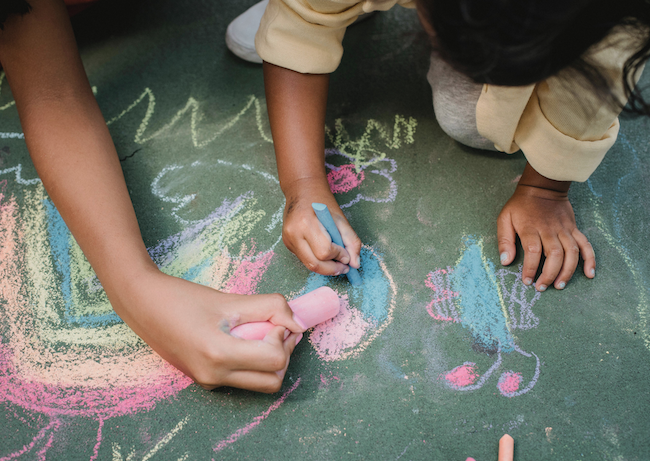
Sometimes the simplest way to break through boredom is to change the rules a little. Take the children outside and give them an hour where the answer to harmless requests is generally yes: yes, you can get muddy; yes, you can make a little stream with the hose; yes, you can collect sticks; yes, you can draw on the pavement with chalk. Obviously, some boundaries still apply, but giving children permission to explore without constantly hearing don't touch that or be careful can make an ordinary afternoon feel surprisingly different.
5. Start a Giant Drawing
Put a large piece of paper on the floor or tape several sheets together and leave out pencils, crayons, pastels or whatever you already have at home. Or get some chalk and head to the yard. Instead of asking children to draw something specific, start with a single mark or shape and invite them to continue the picture. One child might turn it into a city, another into an imaginary map, and someone else might cover the entire thing in colour. If several children are involved, letting them work on the same piece of paper can lead to an entirely unexpected collaborative artwork.
6. Make a Miniature World
Collect small natural objects from the garden or a walk (stones, sticks, leaves, bark, seed pods and flowers) and give children a tray or patch of ground to work with. They can build a fairy garden, woodland village, dinosaur landscape, tiny campsite or anything else their imagination comes up with. There is something absorbing about miniature play because children have to think about the world from a different scale. A pebble becomes a boulder, a twig becomes a bridge and a few leaves can suddenly become a forest.
7. Let Them Cook Something
It doesn't have to be a complicated recipe or a designated baking afternoon. Give children a job in the kitchen that feels genuinely useful: washing fruit, making toast toppings, mixing pancake batter, assembling their own snack plate or helping prepare something for dinner. Older children can be given more independence, while younger ones can simply stir, pour and taste. Cooking naturally gives children something to concentrate on, and there is a satisfying reward at the end that doesn't involve a screen or a toy.
8. Create an Indoor Obstacle Course
Move a few cushions, pillows, chairs and blankets around the living room and let children decide how to get from one side to the other without touching the floor. They can crawl under tables, balance along a line of cushions, climb over a pillow mountain or create their own rules as they go.Once they've mastered it, let them redesign the course. This can turn into a surprisingly long afternoon because children tend to become more interested once they're allowed to change the challenge themselves.
9. Give Them a "Make Something" Basket
Fill a basket or box with things that don't have an obvious purpose: wool, ribbons, cardboard, wooden pegs, paper, stickers, buttons, fabric scraps, tape and natural treasures. Put it somewhere accessible and let children decide what to do with it.The important part is resisting the urge to provide an example. When there isn't a finished project to copy, children have to decide what they're making, which is where much of the creative thinking happens.
10. Let Them Be Bored
This might be the hardest one for adults, but it may also be the most valuable. Sometimes the best response to I'm bored is simply to acknowledge it and let the moment sit for a while rather than immediately filling it. A child might complain, wander around, lie on the floor for ten minutes and eventually begin building something out of cushions. They might find an old book, start drawing, go outside or invent a game with a sibling. That transition can take longer than we'd like, particularly when we're used to children being constantly entertained, but boredom can be the beginning of independent play rather than the end of it.
The goal isn't to make sure children are never bored. Childhood doesn't need to be packed so tightly that every quiet moment has something waiting inside it. Some of those unplanned stretches, the rainy afternoons, the long waits, the days when nobody has organised anything, can become the very moments children remember for their freedom and imagination. So the next time the house fills with I'm bored, there doesn't necessarily need to be a solution waiting. Sometimes a little space, a few ordinary things and enough time for an idea to arrive is more than enough.